

 Italiano
 Deutsch




There are no more items in your cart
SKU:
16564
Brand:
Valentino Butussi
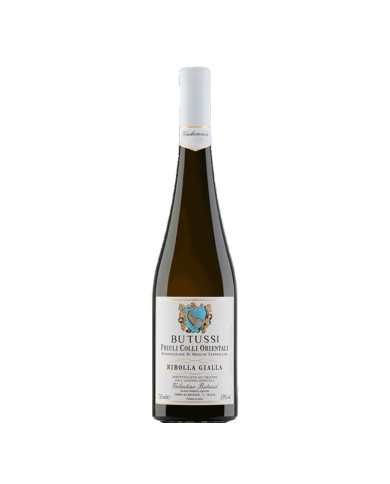
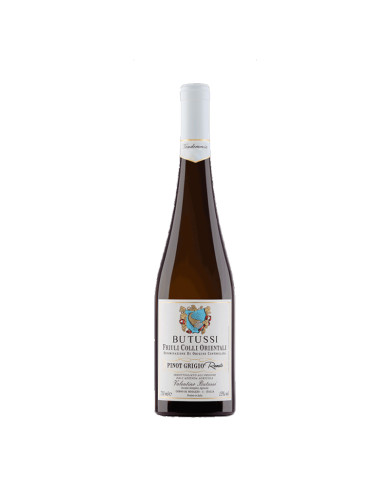
For the vinification of this wine, 30/40% of the grapes are left to dry in wooden boxes for over a month. The remaining grapes are left on the plant and are then harvested when overripe, when the berries begin to darken and dehydrate naturally. The grapes are destemmed and the must is left in contact with the skins for 24-28 hours at a temperature of 12°C to allow the wine to accentuate its varietal characteristics and to acquire the golden yellow-amber color typical of this vine . The refinement takes place for 60% for 6 months in steel tanks, 40% 6 months in 300 liter oak barrels and ends with 2-4 months in the bottle.
€16.40
SKU:
16563
Brand:
Valentino Butussi
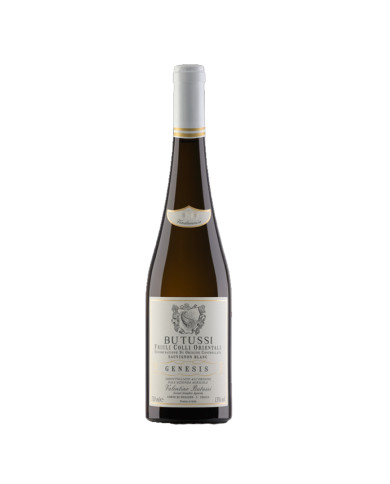
A great wine of the Friulian tradition, Sauvignon, rediscovers its origins in this "Genesis" DOC, a product that conquers nose and smell after a few moments, and which amazes for its excellent evolutionary potential. The grapes, grown in soils rich in limestone and sandstone, come from a single vineyard parcel, whose vines are around forty years old. A bottle with which the Valentino Butussi company raises the bar decisively, proposing to tell the terroir of the Colli Orientali del Friuli with the excellence of limited production, where quality reaches truly remarkable peaks. Just under two thousand bottles for a label that cannot be missing in the cellar of every enthusiast.
€45.86
SKU:
16562
Brand:
Valentino Butussi
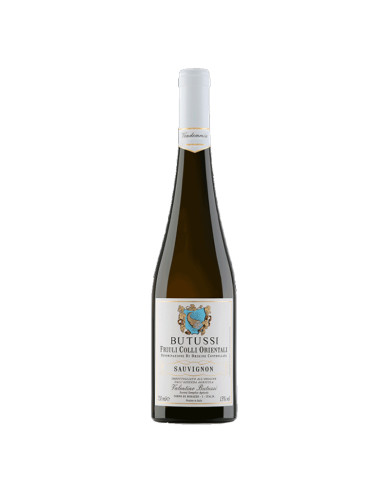
Straw yellow in colour, it has an intense aroma of green pepper, tomato leaves, passion fruit and peach. It is a wine with a fresh, lively, harmonious and velvety flavour.
€15.50
SKU:
16561
Brand:
Valentino Butussi
Harvest The harvest is hand-picked when the grapes reach optimal ripeness and takes place in several stages from the first to the second ten days of October.
Vinification The grapes are destemmed trying to keep the berry whole as much as possible and thus sending it into the barrel. Pumping over is then done until the desired color and tannins are reached and finally it is separated from the skins.
Refinement before the bottle: Matured in precious wood for 14 months and finishes the maturation with a further 4 months in steel barrels
Bottle refinement: 7 months
€19.76
SKU:
16560
Brand:
Valentino Butussi
After the destemming and crushing, the crushed grapes are cooled immediately at a temperature of 12°C and left in contact with the skins for 12 – 16 hours. In this period of time the natural enzymes of the must allow a release of the aromatic components, linked to the skin, accentuating the structure and the typical varietal characteristics of the vine. After this period, the must is delicately separated from the skins and fermented intact, without clarification, at a controlled temperature for about 14 days.
€15.50
SKU:
16559
Brand:
Valentino Butussi
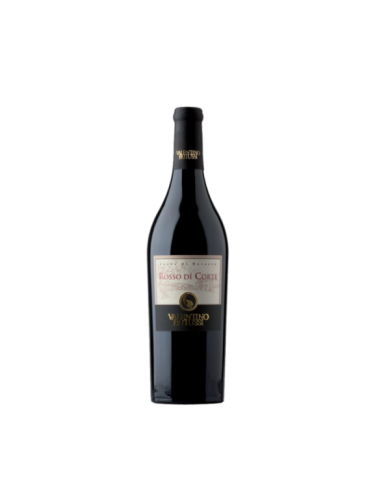
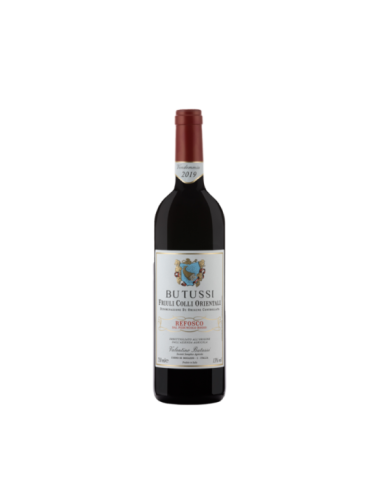
The ruby red color with purplish reflections that fade with ageing. Intense bouquet, which evokes wild blackberries, wild berries with winy and vegetable notes. Strong flavour, the tannins are integrated and the finish is pleasantly bitter. Refosco dal peduncolo rosso is an ancient Friulian vine, perhaps the best Friulian variety of red berried grapes.
€16.50
SKU:
16558
Brand:
Valentino Butussi
The ruby red color with purplish reflections that fade with ageing. Intense bouquet, which evokes wild blackberries, wild berries with winy and vegetable notes. Strong flavour, the tannins are integrated and the finish is pleasantly bitter.
Refosco dal peduncolo rosso is an ancient Friulian vine, perhaps the best Friulian variety of red berried grapes.
€33.00
SKU:
16557
Brand:
Valentino Butussi
A small part (25%) is vinified in white; a part about 40% is placed in cold maceration for 36 hours, for a greater extraction of the pink part. For both, a soft pressing and a start with indigenous fermentation then helped halfway through the addition of a small amount of selected yeast to complete the fermentation. The remaining part of the grapes is pressed, cooled to 7 degrees and left to macerate until the indigenous fermentation begins (usually 5 to 6 days). The macerated product is placed in a press and squeezed at minimum pressure, the must thus obtained continues its fermentation in traditional 2nd and 3rd passage barrels, in non-toasted oak with a capacity of 5/7 HL. One month before bottling, the three different vinifications are combined to form a single wine.
€15.50
SKU:
16556
Brand:
Valentino Butussi
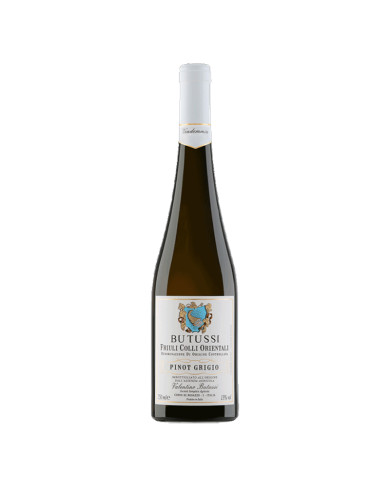
At sight it has a straw yellow color, characterized by soft copper-colored reflections. The nose is typically varietal, with floral notes of acacia flowers which are embellished with touches of green apple and pear. On the palate it is full-bodied, with a savory-acidic vein that makes the sip drinkable. It ends with a finish characterized by a slightly bitter aftertaste.
€15.50
SKU:
16555
Brand:
Valentino Butussi
PIGNOLO BUTUSSI FRIULI VENEZIA GIULIA Grape variety: pure Pignolo Winy, tannic taste, reminiscent of raspberry. It is a wine to be discovered. Wine for meat dishes of Friulian cuisine, especially it prefers the ciàr in padiele (beef stew). Serving temperature: 16 – 18° C
SKU:
16554
Brand:
Valentino Butussi
PIGNOLO BUTUSSI FRIULI VENEZIA GIULIA Grape variety: pure Pignolo Winy, tannic taste, reminiscent of raspberry. It is a wine to be discovered. Wine for meat dishes of Friulian cuisine, especially it prefers the ciàr in padiele (beef stew). Serving temperature: 16 – 18° C
€41.00
SKU:
16553
Brand:
Valentino Butussi
This ancient vine is the pride and joy of Friuli, the grapes are harvested manually and differentiated according to maturation with twice-weekly passages and takes place throughout the month of October. For the vinification of this wine, 10% of the harvested grapes are vinified in the classic way, soft pressing, settling and controlled fermentation. The remaining 90% of the grapes are left to dry for over a month, losing about 40% of the weight. The highly concentrated must obtained is fermented in small oak barrels, where it remains until the summer. Then the two wines are blended and aged for another 4 months in steel barrels. The refinement takes 6-8 months in the bottle.
€49.19
Discover the wines of Friuli-Venezia Giulia: a unique experience for your senses.
Friuli-Venezia Giulia is an Italian region rich in history and culture, but also in quality wines. While it's not the first place that comes to mind when thinking about Italian wine, this region boasts some of the best wines in Italy. So, if you're interested in discovering the wines of Friuli-Venezia Giulia, read on.
What are the main wines of Friuli-Venezia Giulia?
Friuli-Venezia Giulia is a region rich in quality wines, with many renowned and appreciated around the world. Among the region's main wines are whites such as Tocai Friulano, Pinot Grigio, Verduzzo, Ribolla Gialla, and Malvasia, as well as reds such as Refosco, Cabernet Franc, Merlot, Cabernet Sauvignon, and Pinot Noir.
What is the difference between white and red wines from Friuli?
The white wines of Friuli-Venezia Giulia are generally lighter, with floral and fruity notes, while the reds are fuller-bodied, with hints of ripe fruit and spice. The whites are generally best enjoyed fresh, while the reds are better suited to aging.
How to choose the right wine?
Choosing the right wine can be a difficult task, but there are some tips that can help you choose the ideal one. First, it's important to know what you're looking for. For example, if you want a wine to drink now, it's best to choose a white wine, such as Tocai Friulano or Pinot Grigio. If you want a wine that can be aged, then it's better to choose a red wine, such as Refosco or Cabernet Sauvignon.
Secondly, it's important to consider the price. While Friuli-Venezia Giulia wines are generally high-quality, some can be expensive, so it's important to choose a wine that fits your budget.
Finally, it's important to taste the wine before buying it. Many restaurants and wine shops in the region offer wine tastings, so don't hesitate to try one before buying.
How to serve Friuli-Venezia Giulia wines?
Friuli-Venezia Giulia wines can be served at different temperatures, depending on the wine. White wines should be served at 8-10°C, while red wines should be served at 12-14°C. It's also important to ensure glasses are properly clean and dry.
What are the best pairings with Friuli-Venezia Giulia wines?
Friuli-Venezia Giulia wines pair well with a wide variety of foods, from fish and meat dishes to cheeses and fruit. White wines pair very well with fish, white meats, and cheeses, while red wines pair best with red meat, aged cheeses, and dried fruit.
How to store Friuli-Venezia Giulia wines?
To best preserve Friuli-Venezia Giulia wines, it's important to keep them in a cool, dark place. Furthermore, it's important to avoid placing the bottles in an area exposed to direct sunlight or strong vibrations.
Map
The wines of Friuli-Venezia Giulia are among the finest in Italy and are appreciated worldwide. If you'd like to discover these wines, don't hesitate to try one and choose the one that best suits your tastes. Remember to serve it at the right temperature and pair it properly with your dishes for a unique tasting experience.